
How Mold Remediation Works in Dayton, OH
A careful mold remediation job in Dayton, Ohio follows the same eight steps whether it is a bathroom wall or a whole basement. Here is what the independent companies typically do, what to ask at each step, and where Ohio rules come in.
Get a Free Quote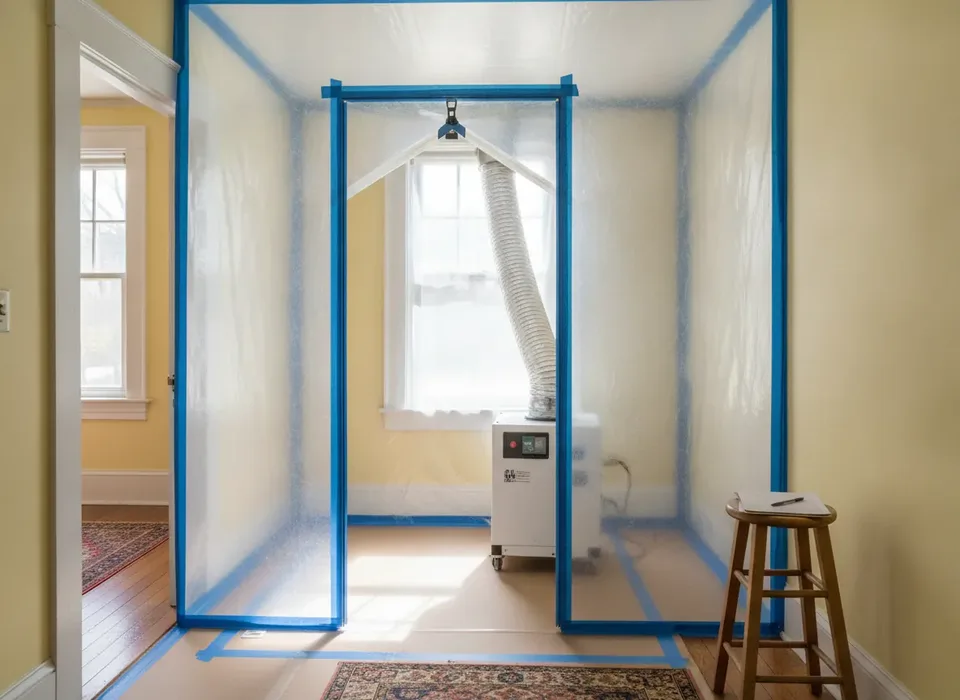
The short version
Find the water. Contain the area. Remove what is moldy and clean what can be cleaned. Dry it and fix the source. Check the result before the walls go back up.
Dayton Mold Remediation Pros is a free quote service and does none of this work itself. The steps below describe what independent Miami Valley mold companies typically do, so you can read their quotes with a clear picture of the job.
Small patches under about 10 square feet can often be cleaned by a homeowner with soap and water, according to the EPA. Public Health - Dayton & Montgomery County does not recommend bleach.
The eight steps of a mold job
Send one request
Use the free quote form or call. Say where the mold is, roughly how big it looks, what got wet and when, the age of the house, whether there is a basement or crawl space, and whether you own or rent. Independent companies that work in your area reply.
Inspection and moisture mapping
Someone looks at the visible mold and traces the water with a moisture meter and often a thermal camera. Lab samples are taken only when they answer a question, such as where hidden mold is. Ideally the inspection is done by someone who does not also sell the removal.
Written scope and contract
You get an itemized written estimate: the areas, containment, what will be removed, drying, clearance and any rebuild. Read it before signing. A sale made at your home generally comes with a 3-business-day right to cancel under Ohio law (ORC 1345.22).
Containment and negative air
The work area is sealed with plastic sheeting and a zippered door, and a negative air machine with a HEPA filter pulls air out of the space so spores do not drift into the rest of the house. Heating and cooling vents in the area are covered.
Removal and cleaning
Moldy porous materials such as drywall, insulation, carpet and pad are cut out, bagged and removed. Framing, block walls and other hard surfaces are HEPA vacuumed and cleaned. Painting over mold is not a fix.
Drying and fixing the water source
The area is dried with dehumidifiers and air movers until moisture readings are back to normal. The water source has to be fixed too: the leak, the sump pump, gutters and downspouts, or grading. Otherwise the mold comes back.
Clearance check
Before walls are closed, the area is checked visually and with a moisture meter, and sometimes sampled. A clearance check by someone independent of the remediator carries the most weight in a home sale or rental dispute.
Rebuild with permits where required
New drywall, insulation, paint and flooring go back in. Cleaning and finish work usually need no permit, but plumbing, electrical, HVAC, structural and roofing work generally do. Check with City of Dayton Building Inspection or your city's building department.
Questions to ask at each step
- Before the inspection: Will you take samples, and what question will they answer? Are you independent of the company that would do the removal?
- Before signing: Can I have an itemized written estimate? What is included and what is extra, such as clearance, rebuild or contents? Can I see your certificate of insurance?
- Before tear-out in an older home: Will suspect materials be tested for asbestos? If the home was built before 1978, is the firm EPA Lead-Safe Certified?
- Before walls are closed: How will you confirm the area is clean and dry? Who does the clearance check?
- For trade work: Who is doing the plumbing, electrical or HVAC work, and is that contractor registered with the City of Dayton where required?
Ohio does not issue a mold-specific license, so these questions do the work a license would. See the FAQ for more on Ohio rules, and the cost guide for typical prices at each step.
How long it takes
A small bathroom or closet job can be a day of work. A finished basement with mold behind the walls can take several days of removal plus several more days of drying before rebuild. The drying step is the one people try to rush, and it is the one that decides whether the mold returns.
If water is still coming in, the clock starts after the source is fixed. Public Health - Dayton & Montgomery County notes mold can begin to grow within one or two days of something getting wet, so stopping the water comes first. See water damage, flood and sump mold and basement mold for what that looks like in Miami Valley homes.
Seeing or smelling mold? Get a clear plan.
Free, no-pressure quotes from independent companies across Dayton, Kettering, Beavercreek, Huber Heights and the Miami Valley.