
48,134 residents
Census Bureau estimate for July 2025, up 3.4% since 2020. Greene County is the growing side of the Miami Valley.
Beavercreek, Ohio, about 7 miles east of downtown Dayton, OH in Greene County, is mostly newer, owner-occupied housing, plus a set of homes and apartments that took a direct hit in the 2019 tornadoes. Dayton Mold Remediation Pros is a free quote service, not a mold company: describe the problem once, and independent local companies reply with quotes.
Get a Free QuoteCensus Bureau estimate for July 2025, up 3.4% since 2020. Greene County is the growing side of the Miami Valley.
About half of Beavercreek homes (48.9%) were built in 1980 or later, much newer than Dayton, OH, where the median is 1951.
Most households own their home, and many have finished the basement. That is where hidden mold tends to show up.
Figures from the Census Bureau's ACS 2024 5-year survey and 2025 population estimates. Beavercreek itself only became a city in February 1980, when part of Beavercreek Township incorporated.
On May 27, 2019, an EF3 tornado tracked about 10 miles from Riverside toward Xenia Township. The National Weather Service found EF3 damage in Beavercreek, including an apartment complex on Anna Laura Lane where much of the roof was torn off and upper exterior walls collapsed. Lighter damage continued into Beavercreek Township.
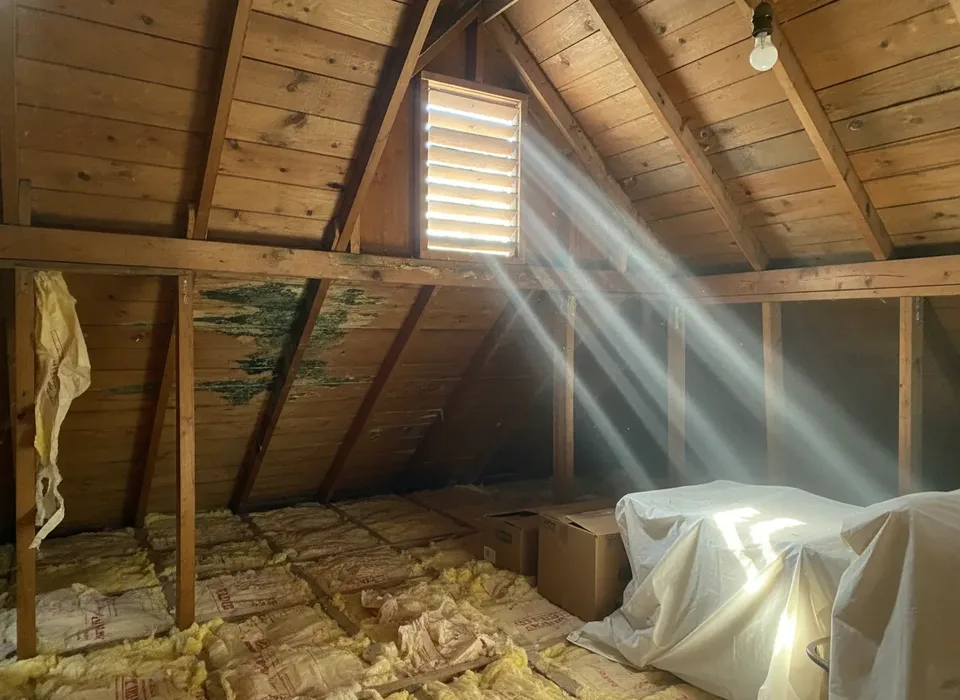
Most homes were rebuilt properly. Some were tarped, patched and left. Rain that came through broken roofs and windows that night could also have soaked wall cavities that were never opened. Today those problems tend to show up as a musty upstairs closet, dark sheathing in the attic, or a ceiling stain that keeps coming back.
If your home was repaired after 2019 and something still smells off, an attic and wall moisture check is a reasonable place to start. See attic and roof-leak mold.
Basements are common across the Dayton, OH area, and newer Beavercreek homes often have finished ones with carpet, drywall and a bathroom. That finish is what hides moisture. Summer humidity around 70%, about 41 inches of rain a year at Dayton International Airport (NOAA 1991–2020), and a sump pump that stops for a few hours during a storm can all leave the bottom of the drywall wet. By late October 2026 the airport gauge had already passed its full-year normal (NOAA daily data), so a lot of basements have been tested this year.
The fix usually means cutting the drywall above the wet line, pulling carpet pad, cleaning and drying the framing, and dealing with the water source: the sump, the grading, or a crack. Published estimates put basement remediation around $1,500–$4,000 (Fixr 2025). Quotes for your home come from the companies.
Before you sign. Ask for a certificate of insurance, a written contract with an itemized scope, and whether clearance testing is included. Ohio does not issue a mold-specific license, so licensing is not something to check; insurance, a written scope and complaint history with the Ohio Attorney General and BBB are. After the 2019 storms, the Ohio Attorney General pursued cases against contractors accused of taking payment for roof work and doing little or nothing, so be careful with large deposits.
It can. A roof that was patched quickly after a storm, rather than properly replaced, can let small amounts of water into the attic for years. Look for dark staining on the roof sheathing near nails and eaves, damp or flattened insulation, and ceiling spots on the top floor. A moisture check in the attic will tell you whether it is old staining or an active leak.
A musty smell that does not go away, damp carpet or tack strip along an outside wall, swelling baseboards, and staining at the bottom of the drywall are the usual signs. A company can use a moisture meter and, if needed, a small inspection opening. Air or surface testing is optional when the source is hidden, but there are no Ohio mold limits to compare against.
Ohio's Home Solicitation Sales Act generally gives you three business days to cancel a sale made at your home. An emergency waiver of that right must be your own handwritten, signed statement, so be wary of anyone with a pre-printed waiver. Get a written contract, avoid large deposits and cash to individuals, and report problems to the Ohio Attorney General.
Share your ZIP, where the mold is, about how big an area, and whether it followed a leak, a storm repair or a wet basement. Independent companies that serve Beavercreek and Greene County reply to you directly. Call (937) 466-8339
See all service areas or the Dayton, OH home page.
Free, no-pressure quotes from independent companies across Dayton, Kettering, Beavercreek, Huber Heights and the Miami Valley.