
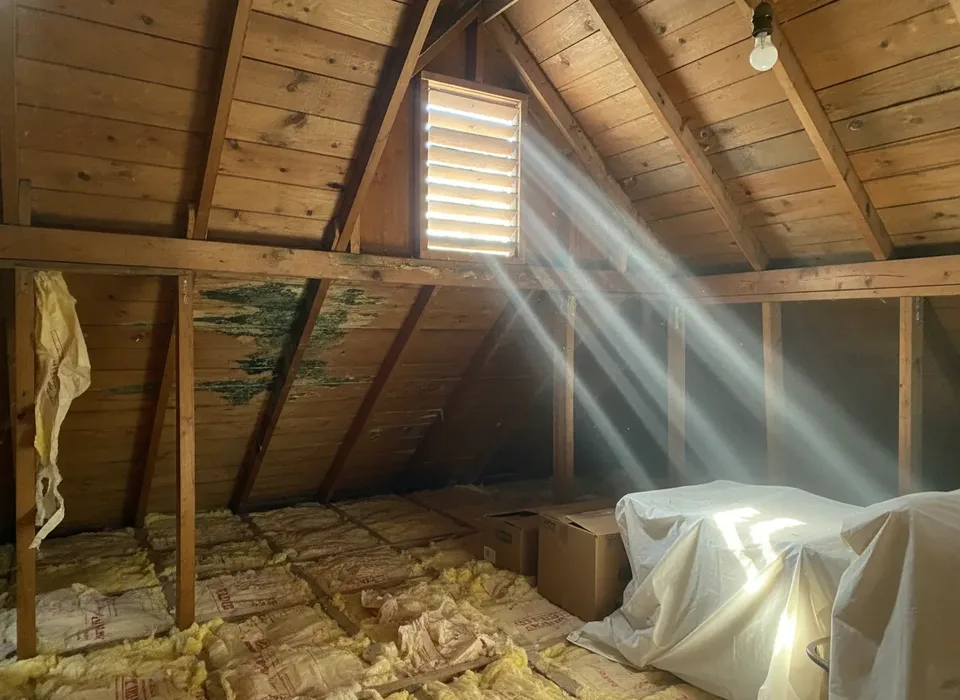
Most people find attic mold by accident: on a trip up for holiday boxes, during a home inspection, or when a roofer pulls a few boards. The stains are usually dark gray or black on the underside of the roof sheathing, heaviest near the eaves or around a bathroom fan.
Why attics in the Miami Valley get wet
The local climate works on attics from both sides. Dayton International Airport averages about 110 nights a year at or below freezing and about 25 inches of snow, and average humidity runs about 70% (NOAA 1991–2020). Precipitation tops 2.35 inches in every month, so there is no dry season for an attic to recover.
- Winter: cold roof sheathing is the coldest surface in the house. Warm, moist air that leaks up from bathrooms, kitchens and living space condenses on it, sometimes as frost that melts on sunny days.
- Snow and thaw: heat escaping through the ceiling melts snow on the upper roof, and the water refreezes at the cold eaves, forming an ice dam.
- Spring and summer: April and May are the wettest months, at 4.46 and 4.51 inches, and that is when older or patched roofs show their leaks.
Ice dams and attic mold
An ice dam is a ridge of ice at the roof edge that holds back meltwater. The pooled water backs up under shingles and soaks the sheathing, insulation and sometimes the top of the wall below. Ohio's Residential Property Disclosure Form names ice damming as one of the causes of water damage to floors, walls or ceilings that sellers are asked about.
The fix is rarely just a roof job. Ice dams form because heat is reaching the roof deck. Common causes are thin or uneven insulation, gaps around ceiling lights and attic hatches, and blocked soffit vents. Sealing air leaks and restoring ventilation is what keeps the next winter's dam from forming.
Storm-damaged and patched roofs since 2019
The 2019 Memorial Day tornadoes damaged roofs across the area. In Trotwood alone, 500 homes were damaged and 59 destroyed. The storms brought EF3 damage to Beavercreek and cut through Old North Dayton and Shiloh. Many roofs were fully replaced. Others were tarped, patched or repaired quickly, sometimes by contractors who later faced fraud cases from Ohio's Attorney General.
A roof that was patched rather than properly repaired can leak a little in every hard rain for years. The first sign is often not a ceiling stain but a musty attic, compressed or matted insulation, or rusty nail tips poking through the sheathing. If you bought a home in a storm-affected area since 2019, the attic is worth a look.
Bath fans, dryer vents and other moisture sources
A surprising amount of attic mold comes from inside the house. Bathroom fans that dump into the attic instead of outdoors, disconnected or crushed fan ducts, and kitchen or dryer vents that end in the attic all pump warm, wet air onto cold wood. Mold around one fan location, with clean sheathing elsewhere, is a strong clue.
| What you see | Likely cause | Who usually fixes the cause |
|---|---|---|
| Stains heaviest at the eaves | Ice dams, blocked soffit vents | Insulation and ventilation work; roofer if shingles are damaged |
| Mold around a bath fan or duct | Fan venting into the attic | Contractor rerouting the duct outdoors |
| Even staining across the north slope | Condensation from air leaks | Air sealing and insulation |
| Stains around a chimney, vent pipe or valley | Flashing leak | Roofer |
| Frost on nails in winter | Warm, moist air reaching the roof deck | Air sealing and ventilation |
What the companies typically do
Inspect and map moisture
Check sheathing with a moisture meter, look at vents, fans and flashing, and decide whether the mold is active or old.
Fix the source
Roof, flashing, fan ducts and ventilation come first, often by another trade.
Contain and clean
Set up HEPA filtration, remove wet or moldy insulation, and clean or treat the sheathing. Badly damaged boards may be replaced.
Check the result
Confirm the wood is dry and the visible growth is gone. Clearance testing by an independent inspector is optional and most useful for a sale or dispute.
What attic mold costs
Published estimates put attic mold remediation at $1,000–$4,000 (This Old House 2026), with Fixr reporting jobs up to $9,000. A Dayton mold inspection runs $292–$457 (homeyou, Sep 2026). Roof, insulation and ventilation repairs are separate. These are published estimates, not quotes; companies quote after seeing the attic. The mold remediation cost guide for Dayton, OH has a calculator.
Permits, insurance and contracts
Cleaning and insulation work usually need no permit. Roofing, structural, storm-damage, electrical and HVAC repairs generally do; check with City of Dayton Building Inspection or your city's building department. For insurance, sudden storm damage is handled differently from a slow leak or condensation, which policies usually exclude; see does homeowners insurance cover mold in Ohio. Get a written contract, and remember Ohio's 3-day cancel right for sales made at your home.
For more on causes and fixes, see the attic and roof-leak mold page.
Frequently asked questions
Can ice dams cause attic mold?
Yes. An ice dam holds meltwater at the roof edge, and that water can work under shingles and wet the sheathing and insulation near the eaves. Repeated wetting through a winter can lead to mold on the roof boards. The Ohio disclosure form even lists ice damming as a cause of water damage. Fix the heat loss and ventilation, not just the stain.
Is attic mold dangerous?
Any type or color of mold can bother people who are sensitive to it, and attic air can move into living spaces through gaps around lights and hatches. That said, attic mold is usually a building problem first: it shows where moisture is getting in. If anyone in the home has symptoms, see a doctor, and fix the moisture source either way.
Do I need a permit to fix attic mold in Dayton, OH?
Cleaning mold and replacing some insulation usually needs no permit. Roofing, structural repairs, storm-damage repairs and electrical or HVAC changes such as rerouting a bath fan duct generally do. Check with City of Dayton Building Inspection or your city's building department, and ask the company who will pull any permit.
Will a new roof fix attic mold?
A new roof stops leaks, but it does not clean existing mold, and it will not help if the real cause is a bath fan venting into the attic or warm air leaking up from the house. Ask for the moisture source to be identified first. Then plan roofing, ventilation and mold cleanup together so the order of work makes sense.
Get free quotes from independent companies
Tell us what you saw in the attic, the age of the roof and any storm repairs, and independent companies across Dayton, Trotwood, Beavercreek, Xenia and the Miami Valley will reply with quotes. Request a free quote or call (937) 466-8339. Dayton Mold Remediation Pros is a free quote service and does not inspect or repair attics or roofs itself.