
If you live in Dayton, Ohio and just found a dark patch on a basement wall or smelled something musty after a storm, your first question may be whether you need a mold test. Often you don't. Sometimes it is the most useful thing you can buy.
This guide follows the US EPA and Public Health - Dayton & Montgomery County. It covers when testing helps, what it can and can't tell you, and how to pick an inspector in a state that does not license them.
The short answer. If you can see or smell mold, testing usually isn't needed. Fix the water and remove or clean the moldy material. Testing earns its cost when the mold is hidden, after cleanup, in a home sale, or when you need documentation.
What Public Health and the EPA say about mold testing
Public Health - Dayton & Montgomery County follows EPA guidelines, which do not recommend routine testing. In its words, "If you can see or smell mold, you already know you have a mold problem." EPA adds that when visible mold is present, sampling is usually unnecessary, and that no EPA or other federal limits have been set for mold.
Ohio has no state limit either. That means no lab result can tell you a home is "safe" or "unsafe" by law. It also means the money is usually better spent finding the water source and removing damaged material.
Public Health also does not do in-home inspections or indoor testing. If you want samples taken, you hire a private company.
When mold testing does help
- Hidden mold. You smell it but can't find it, for example behind finished basement walls, under flooring or inside a wall after a leak.
- Clearance after remediation. EPA notes that surface sampling can help show whether an area was adequately cleaned. Clearance from someone other than the remediator is a strong check on the work.
- Buying or selling. The Ohio Residential Property Disclosure Form asks whether the home was ever inspected for mold by a qualified inspector, and it encourages buyers who are concerned to get one. See buying or selling a house with mold in Ohio.
- Documentation. Renters, landlords and insurance claims sometimes need a written record of what was found and where.
- Health questions. If someone in the home is sensitive to mold, a doctor may want to know more. Any type of mold can bother sensitive people, so talk with a doctor about symptoms.
What a mold test can and can't tell you
| A test can | A test can't |
|---|---|
| Show whether indoor air differs from an outdoor sample taken the same day | Tell you a level is legally safe, because no federal or Ohio limit exists |
| Identify the kinds of mold on a surface sample | Find the water source by itself |
| Support a clearance check after cleanup | Replace a visual inspection and moisture readings |
| Give you a dated record for a sale or dispute | Tell you how a specific person will react |
Results are also a snapshot. Air samples change with weather, activity in the house and whether the furnace is running. A good inspector explains those limits in writing.
Home settle-plate kits nearly always grow something, because mold spores are a normal part of indoor air. The Ohio disclosure form itself tells buyers that every home contains mold. A positive kit result alone tells you little.
Inspection versus testing
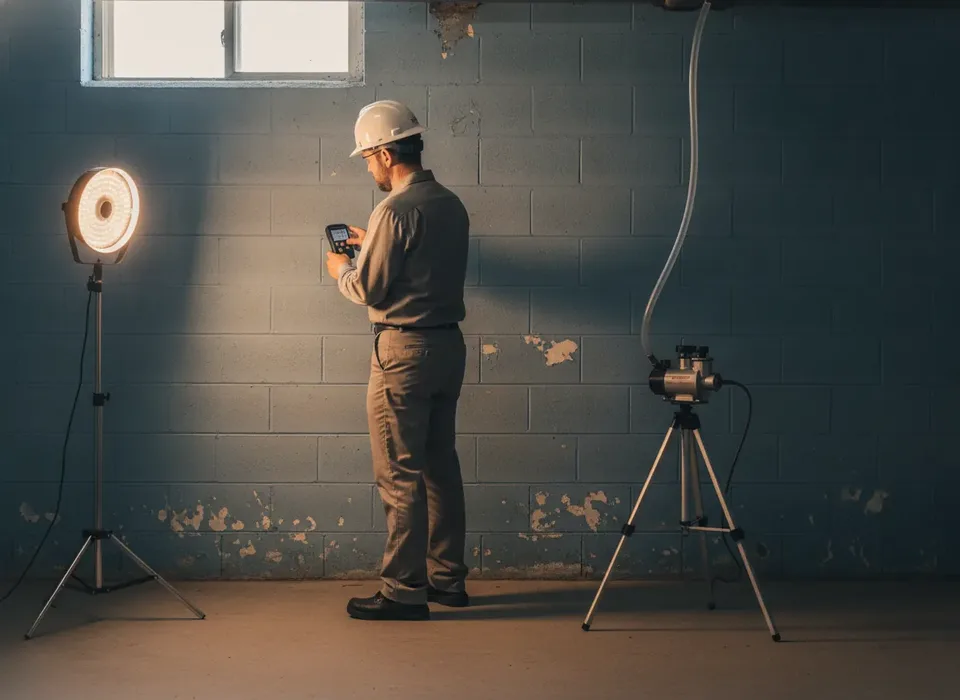
An inspection is the part that usually matters most: a walk-through with a flashlight, a moisture meter and often a thermal camera, looking for wet materials and the path the water took. Testing is optional add-on sampling, sent to a lab. In older Miami Valley homes with block or poured basement walls, the inspection often ends at the sump pit, a crack at the wall-floor joint or a downspout dumping next to the foundation.
Ask for a written report with photos, moisture readings, a sketch of affected areas, sample locations and the lab's results. Learn more on our mold inspection and testing page for Dayton, Ohio.
Independent inspector or the remediation company?
Many remediation companies offer free estimates and will look at visible mold at no charge. That is useful for a straightforward job. But when the same company tests, writes the scope and does the work, it is grading its own paper.
For larger jobs, hidden mold, a purchase or clearance, consider an inspector who does not do remediation. Ask any inspector directly whether they or a related company would bid on the removal.
What mold testing costs
Published estimates, not quotes (homeyou Sep 2026; Fixr 2025). Dayton quotes come from the companies, not from this site.
| Item | Typical range | Source |
|---|---|---|
| Mold inspection, Dayton | $292–$457 | homeyou, Sep 2026 |
| Inspection with lab testing, national | $450–$800 (avg ≈ $500) | Fixr 2025 |
| Air testing | $500–$700 | Fixr 2025 |
The number of samples drives most of the difference. Ask how many samples are included and what each extra one costs. The mold remediation cost guide covers the removal side.
Ohio doesn't license mold inspectors, so ask these questions
Ohio issues no mold-specific license for inspectors or remediators, and Public Health - Dayton & Montgomery County does not regulate mold. Private certifications exist and are a reasonable extra, but they are not a legal requirement. Ask instead:
- Do you carry general liability insurance, and can I see a certificate?
- Will you take moisture readings and photos, and put everything in a written report?
- Which lab analyzes the samples, and will I get the lab report itself?
- Do you or a related company do remediation work?
- Are you registered with the Ohio Secretary of State, and what does your complaint history with the Ohio Attorney General and BBB look like?
If the home was built before 1980 and tear-out is likely, also ask whether you should test suspect materials for asbestos or lead first. Those are separate tests with their own Ohio licensing.
Frequently asked questions
Will Public Health test my Dayton, Ohio home for mold?
No. Public Health - Dayton & Montgomery County says it cannot provide indoor mold testing and does not do in-home mold inspections. It follows EPA guidance and suggests contacting a qualified mold remediation business. If you want testing, you hire a private inspector, ideally one that does not also do the removal work.
Is there a safe level of mold in Ohio?
No official one. There are no federal or Ohio limits for mold in homes, so a lab number cannot be compared against a legal standard. Inspectors usually compare indoor samples with an outdoor sample and look at which kinds of mold show up. What matters most is whether materials are wet and growing mold.
Do I need a mold test before remediation?
Usually not if you can see or smell the mold. EPA and Public Health say visible mold means you already know you have a problem, and the next steps are fixing the water and removing or cleaning moldy materials. Testing helps more when the mold is hidden, after cleanup for clearance, or in a sale or rental dispute.
Are free mold inspections worth it?
A free visit from a remediation company is really an estimate. It can be useful for a visible problem, but the company that finds the mold is also the one selling the removal. For a large job, hidden mold, a home purchase or clearance, a paid independent inspection avoids that conflict. Many companies offer free estimates.
Not sure whether you need a test or a cleanup? Describe what you see or smell and independent Miami Valley inspection and remediation companies can reply, or call (937) 466-8339. You can also read about mold removal and remediation.