
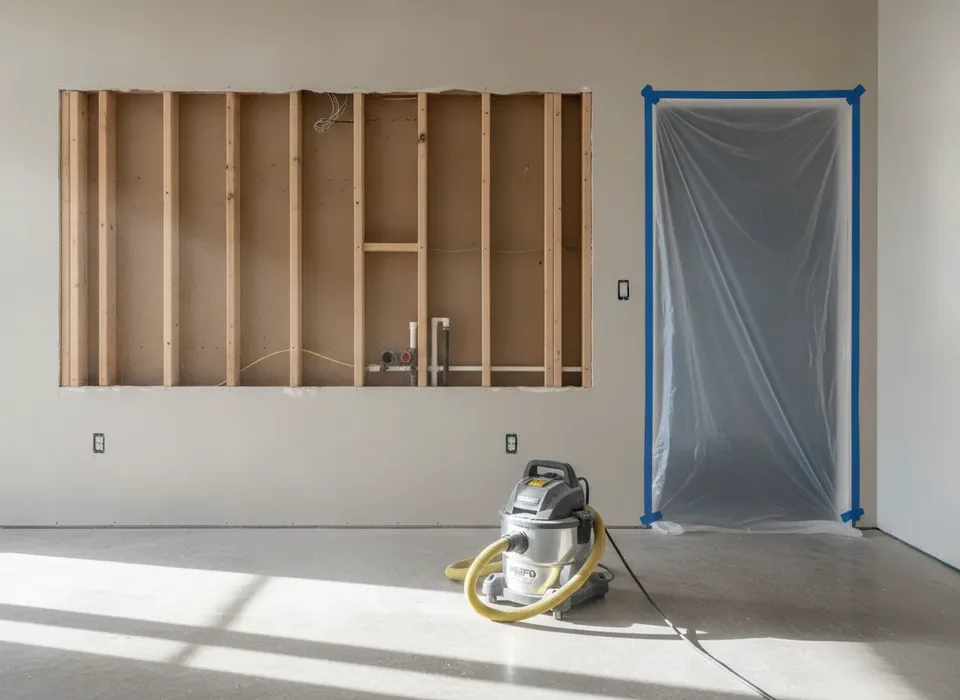
If you found mold in a home in Dayton, Ohio and the quotes you collected are thousands of dollars apart, you are not alone. Mold work is priced from what a company expects to find inside walls, basements, crawl spaces and attics, so two honest quotes can look very different.
This post explains what moves the number and how to read the paper it comes on. For the full price table and a planning calculator, see the mold remediation cost guide for Dayton, OH.
Where the numbers come from. Dayton Mold Remediation Pros is a free quote service, not a mold company or a contractor. The ranges below are national and local estimates published by third parties. Your quotes come from the independent companies, not from this site.
How much does mold remediation cost in Dayton, Ohio?
Published guides put most remediation jobs at $10–$25 per square foot of affected area. This Old House puts a typical job at $1,200–$3,750, and Fixr's broader range runs $1,500–$9,000. Where the mold is matters as much as how much there is.
Published estimates, not quotes (homeyou Sep 2026; Fixr 2025; This Old House Mar 2026). Dayton quotes come from the companies, not from this site.
| Item | Typical range | Source |
|---|---|---|
| Mold inspection, Dayton | $292–$457 | homeyou, Sep 2026 |
| Inspection with lab testing, national | $450–$800 (avg ≈ $500) | Fixr 2025 |
| Mold remediation, per sq ft | $10–$25 | This Old House 2026 (Fixr: $10–$30) |
| Typical remediation job | $1,200–$3,750 (avg ≈ $2,300) | This Old House 2026 |
| Bathroom | $500–$1,500 | Fixr 2025 |
| Basement | $1,500–$4,000 | Fixr 2025 (This Old House: $500–$3,000) |
| Crawl space | $500–$2,000 | Fixr 2025; This Old House 2026 |
| Attic | $1,000–$4,000 | This Old House 2026 (Fixr: up to $9,000) |
| HVAC / ducts | $3,000–$10,000 | Fixr 2025 |
Quick math: a 100 square foot area at $10–$25 per square foot comes to roughly $1,000–$2,500 before testing, trade repairs or rebuild. Treat that as a planning figure, not a price.
Seven things that move a mold quote
1. The size of the affected area
Per-square-foot prices refer to the moldy and water-damaged area, not the room. A small stain under a sink and a whole wall behind a finished basement are very different jobs. Companies often open a wall to find where the damage ends, so a good quote names a measured area and says what happens if more turns up.
2. What the mold is growing on
Hard surfaces such as concrete, tile, metal and sealed wood can usually be cleaned. Porous materials like drywall, insulation, carpet pad and ceiling tile that have grown mold are usually cut out and bagged. More removal means more labor, more disposal and more rebuilding later.
3. How hard the area is to reach
Crawl spaces and attics cost more per square foot of work because crews move slowly, carry gear through small openings and wear more protection. Basements are easier to reach but often hide damage behind paneling and carpet. See basement mold and crawl space mold for those settings.
4. Whether the water is still getting in
Mold returns if the moisture does. The Dayton International Airport gauge averages 41.33 inches of rain a year (NOAA 1991–2020), and no month averages less than 2.35 inches, so there is no long dry season to hide a leak. Ask each company to name the source: a tired sump pump, grading that slopes toward the house, a plumbing leak or a roof. Then ask whether the fix is in their scope, a separate trade, or yours to arrange.
5. The age of the house
The median home in the city of Dayton was built in 1951, and 85.4% of homes were built before 1980 (ACS 2024). Before tear-out in an older house, ask whether pipe insulation, floor tile, mastic or ceiling texture will be tested for asbestos, and whether paint will be treated as lead paint. Larger asbestos jobs need an Ohio EPA-licensed asbestos contractor, lead abatement licensing comes from the Ohio Department of Health, and paid paint work in pre-1978 homes falls under EPA's Lead-Safe rule. Those steps can add line items.
6. Trade work and permits
Cleaning and small tear-out usually need no permit. Plumbing, electrical, HVAC, structural, roofing and storm-damage repairs generally do, so check with City of Dayton Building Inspection or your city's building department. In Dayton rentals and other non-owner-occupied homes, plumbing, electrical and HVAC work must be done by a City-registered contractor, which can change who does part of the job.
7. Clearance testing and rebuild
Remediation usually ends when the work area passes a clearance check. Some companies include it; others expect you to hire an independent tester. Putting back drywall, insulation, paint and flooring is a separate scope that may be priced on the same quote or left off entirely. Ask.
How to read a mold quote line by line
| Line on the quote | What it should tell you |
|---|---|
| Moisture source | What caused the mold and who fixes it |
| Affected area | Measured square footage and which rooms or surfaces |
| Containment | Plastic sheeting, zippered doors and how the area is sealed off |
| Air filtration | HEPA air scrubbers or negative air, and for how long |
| Removal and disposal | Which materials come out and how they leave the house |
| Cleaning and drying | HEPA vacuuming, cleaning of framing, dehumidifiers and target moisture readings |
| Clearance | Visual check, moisture readings or testing, and who performs it |
| Exclusions and changes | What is not included and how hidden damage is priced |
If two quotes differ by a lot, put them side by side in this order. The gap usually sits in one or two lines.
Ohio protections to know before you sign
- Get a written contract and an itemized estimate, with start and end dates.
- For a sale made at your home, Ohio's Home Solicitation Sales Act generally gives you 3 business days to cancel (ORC 1345.22).
- An emergency waiver of that right must be your own handwritten, signed statement. Be wary of anyone who hands you a pre-printed waiver.
- Avoid large deposits and cash or checks made out to an individual.
- Check the company's Ohio Secretary of State business registration and its complaint history with the Ohio Attorney General and the BBB.
After the 2019 Memorial Day tornadoes, the Ohio Attorney General brought cases against contractors who took payment for storm repairs and did little or no work. Most companies are honest, but the paperwork protects you either way. Our guide to hiring a mold remediation company in Ohio has the full checklist.
Will insurance pay for any of it?
Sometimes. Mold is usually covered only when it follows a covered, sudden water loss such as a burst pipe. Seepage, sump failure and sewer backup usually need a separate endorsement, and flood needs a separate flood policy, typically with a 30-day wait. Call your agent before work starts, take photos and keep every invoice. See does homeowners insurance cover mold in Ohio for more.
Ways to keep the bill reasonable
- Stop the water first, and don't scrub or sand large moldy areas yourself.
- Under about 10 square feet, EPA says homeowners can often clean it themselves with soap and water. Public Health does not recommend bleach.
- On larger jobs, consider an independent mold inspection so the scope is not written by the company doing the work.
- Get two or three written quotes for the same scope, with rebuild priced separately.
Frequently asked questions
Why are my Dayton, Ohio mold quotes so far apart?
Most gaps come from scope, not markup. One quote may include containment, HEPA air filtration, clearance testing and rebuild, while another covers only removal. Companies also guess differently about hidden damage behind walls. Line the quotes up item by item, ask what each one excludes, and ask how the price changes if more damage turns up.
Does a mold remediation quote include fixing the water problem?
Often not. Remediation companies remove and clean mold and dry the area, but sump pump, plumbing, grading and roof repairs are often a separate trade. Ask each company to name the moisture source and say whether the fix is in its price. In Dayton rentals, plumbing, electrical and HVAC work must be done by a City-registered contractor.
How much does a mold inspection cost in Dayton, Ohio?
homeyou put a Dayton mold inspection at about $292 to $457 in September 2026. Fixr's 2025 national range for an inspection with lab testing is $450 to $800, and air testing alone runs about $500 to $700. These are published estimates. Many remediation companies offer free estimates, which are different from an independent inspection.
Can I cancel a mold contract I signed at my kitchen table?
Usually, yes. Ohio's Home Solicitation Sales Act generally gives you until midnight of the third business day to cancel a sale made at your home (ORC 1345.22). An emergency waiver of that right must be your own handwritten, dated and signed statement. This is general information, not legal advice.
Ready for real numbers? Describe your mold problem once and independent Miami Valley companies can reply with quotes, or call (937) 466-8339. For the service itself, start with mold removal and remediation.