
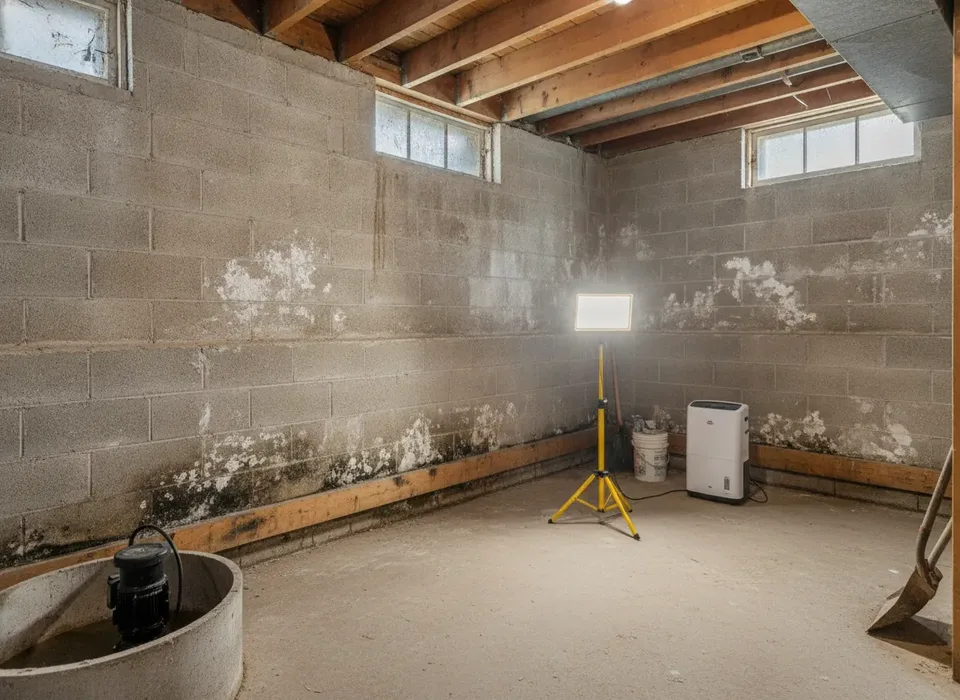
Basement mold is one of the most common mold problems in Dayton, Ohio, and it usually announces itself with a smell before anyone sees it. Basements are common across the Miami Valley, most homes are decades old, and the weather keeps the ground wet in every season.
This guide explains why basements here get musty, how to tell mold from mineral deposits, what you can handle yourself, and when it is time to get quotes.
Found mold in the basement today? Stop any water you can, check that the sump pump runs, take photos, keep kids and pets out, and don't scrub or sand large areas. Under about 10 square feet, EPA says you can often clean it yourself. Bigger than that, get help.
Why basements in Dayton, Ohio get damp and musty
Rain in every month
The Dayton International Airport gauge averages 41.33 inches of precipitation a year (NOAA 1991–2020). April and May are the wettest months at about 4.5 inches each, and no month averages less than 2.35 inches. By late October 2026 the airport gauge had already passed its full-year normal (NOAA daily data), so many basements that stayed dry in past years took on water this year.
A river valley over saturated ground
Much of the Dayton area sits in a river valley over saturated sand and gravel that is fed by the rivers. The City of Dayton describes the Great Miami Buried Valley Aquifer as completely saturated with water and replenished by the rivers above it. Basements near the Great Miami, Stillwater and Mad rivers and their creeks are prone to seepage and depend on their sump pumps.
The Miami Conservancy District dams built after the 1913 Great Dayton Flood protect the region from big river floods. They do not stop groundwater from seeping through a basement wall, a sump from failing, or a sewer from backing up.
Old houses, old foundations
The city's median home was built in 1951, 36.7% of homes predate 1940 and 85.4% predate 1980 (ACS 2024). Many older basements were built without modern exterior waterproofing, and decades of freeze-thaw cycles open cracks. The airport averages about 110 nights a year at or below freezing.
Summer condensation
Outdoor humidity averages about 70%, and summers are warm and humid. When that air reaches cool basement walls, slabs and cold-water pipes, it condenses. That is why a basement can feel damp in August with no leak at all.
Is it mold or efflorescence?
| Sign | Efflorescence | Mold |
|---|---|---|
| Looks like | White, crystalline, powdery | Fuzzy or slimy; white, green, gray, black or other colors |
| Grows on | Concrete, block, brick, mortar | Wood, drywall, paper, carpet, dust, stored boxes |
| Rub test | Crumbles; dissolves in water | Smears; doesn't dissolve |
| Smell | None | Musty |
| What it means | Water is moving through the wall | Something is staying wet |
Efflorescence isn't mold, but it is a warning. The same water that leaves salts on the block can soak framing, paneling and carpet nearby.
Finished basements hide the problem
Many Miami Valley basements have been finished with drywall, paneling and carpet. Those materials hide water and feed mold. Common signs include a musty smell that gets worse after rain, a damp carpet tack strip along the outside walls, swollen baseboards, and stains on the bottom of drywall. Mold often grows on the back of drywall where you can't see it.
If you smell mold but can't find it, an inspection with moisture readings is often more useful than a lab test. See do you need mold testing.
Sump pumps and sewer backups
A sump pump that fails during a storm can put inches of water on the floor in hours. A sewer backup is worse, because the water is contaminated. Either one calls for fast drying and careful cleanup. Our sump pump failure checklist walks through the first 48 hours.
Insurance matters here. Sump failure and sewer backup usually need a separate endorsement on a homeowners policy, and flood needs a separate flood policy. Check your declarations page before the next storm.
What you can handle yourself
- Run a dehumidifier. EPA recommends keeping indoor humidity below 60 percent, ideally 30 to 50 percent. Use a drain hose so it runs continuously.
- Dry anything wet within 24 to 48 hours, as EPA advises.
- Clean small patches, under about 10 square feet, with soap and water while wearing gloves and a mask. Public Health does not recommend bleach.
- Throw out moldy cardboard boxes and stored paper.
- Extend downspouts and check that soil slopes away from the foundation.
- Test the sump pump each spring by pouring water into the pit.
When to call in remediation companies
Get quotes when mold covers more than about 10 square feet, when it is on drywall, insulation or carpet, when it keeps coming back, after a sewer backup, or when anyone in the home has health concerns (see a doctor about symptoms). Companies typically map moisture, set up containment and HEPA air filtration, remove damaged porous materials, clean framing, dry the space and check the result. Our basement mold page covers the work in more detail.
What basement mold remediation costs
Fixr's 2025 range for a basement is $1,500–$4,000, and This Old House lists $500–$3,000. These are published estimates, not quotes; Dayton quotes come from the companies. A finished basement usually costs more because materials come out and later go back in. The fix for the water source, such as a new sump pump, drainage work or wall repair, is often a separate trade. See the mold remediation cost guide for the full table and a calculator.
In a home built before 1980, ask whether floor tile, mastic or pipe insulation will be tested for asbestos before demolition. If the job includes plumbing or electrical changes, those generally need a permit, and in Dayton rentals they must be done by a City-registered contractor.
Frequently asked questions
Why does my basement smell musty after heavy rain?
Rain raises the water around the foundation, and some of it pushes through cracks, the wall-floor joint or a sump pit that can't keep up. Even without visible water, damp concrete raises basement humidity. A musty smell usually means something is staying wet long enough to grow mold, often carpet, drywall, paneling or stored cardboard.
Is white powder on my basement wall mold?
Often it is efflorescence: mineral salts left behind as water moves through concrete or block and evaporates. It is crystalline, crumbles when rubbed and dissolves in water. Mold is fuzzy or slimy, smells musty and grows on wood, drywall, paper or dust. Efflorescence isn't mold, but it shows water is coming through the wall.
What humidity should a basement be in Ohio?
EPA recommends keeping indoor humidity below 60 percent, ideally between 30 and 50 percent. In a Miami Valley basement that often means running a dehumidifier from spring through fall, with a drain hose to a floor drain or sump so it doesn't stop when the bucket fills. A cheap hygrometer tells you whether it is working.
How much does basement mold remediation cost?
Fixr's 2025 range for basement mold remediation is $1,500 to $4,000, and This Old House lists $500 to $3,000. Finished basements usually cost more because drywall, carpet and paneling may have to come out, then go back in. These are published estimates, not quotes. Dayton prices come from the companies after they see the space.
Musty basement or visible mold? Tell us what you see once and independent Miami Valley companies can reply with quotes, or call (937) 466-8339. If water just got in, start with water damage, flood and sump mold.